


Understanding our emissions is the first step towards meaningful climate action.
Secret Linen Store is committed to supporting the global ambition to limit global warming to 1.5°C above pre-industrial levels.
As a small business, we want the commitments we make to be meaningful, measurable and grounded in a clear understanding of our impact. Our FY2024/25 carbon mapping established our first comprehensive emissions baseline, giving us a much clearer picture of where our emissions occur and where we can have the greatest influence.
Our Carbon Footprint in Numbers
For the 2024/25 reporting period, Secret Linen Store’s total emissions were calculated as:
1,837.14 tonnes of CO₂e
These emissions fall into three categories:
- Scope 1 – Direct emissions: 1.92 tCO₂e (0.10%)
- Scope 2 – Electricity use: 7.27 tCO₂e (0.40%)
- Scope 3 – Value chain emissions: 1,827.95 tCO₂e (99.5%)
As with many retail businesses, the majority of our emissions occur outside our direct operations, within our supply chain and product lifecycle.
To help track progress over time, we also measured emissions intensity:
- 211.94 tCO₂e per £1 million revenue
- 79.88 tCO₂e per full-time employee
These metrics provide useful benchmarks that we can monitor as we continue improving our data and reduction efforts.
Where Our Biggest Impact Sits
TOur first carbon assessment showed us very clearly where we need to focus.
Approximately 99.5% of our emissions sit within Scope 3, with purchased goods and services representing the significant majority of our footprint.
This means that while reducing the impact of our own operations remains important, our biggest opportunity lies within the products we make, the materials we choose and the suppliers we work with.
This insight is helping us focus our climate action where it can have the greatest impact.
What We’re Already Doing
Reducing our environmental impact has been part of Secret Linen Store’s mission for many years. Some of the initiatives already in place include:
Responsible sourcing and manufacturing
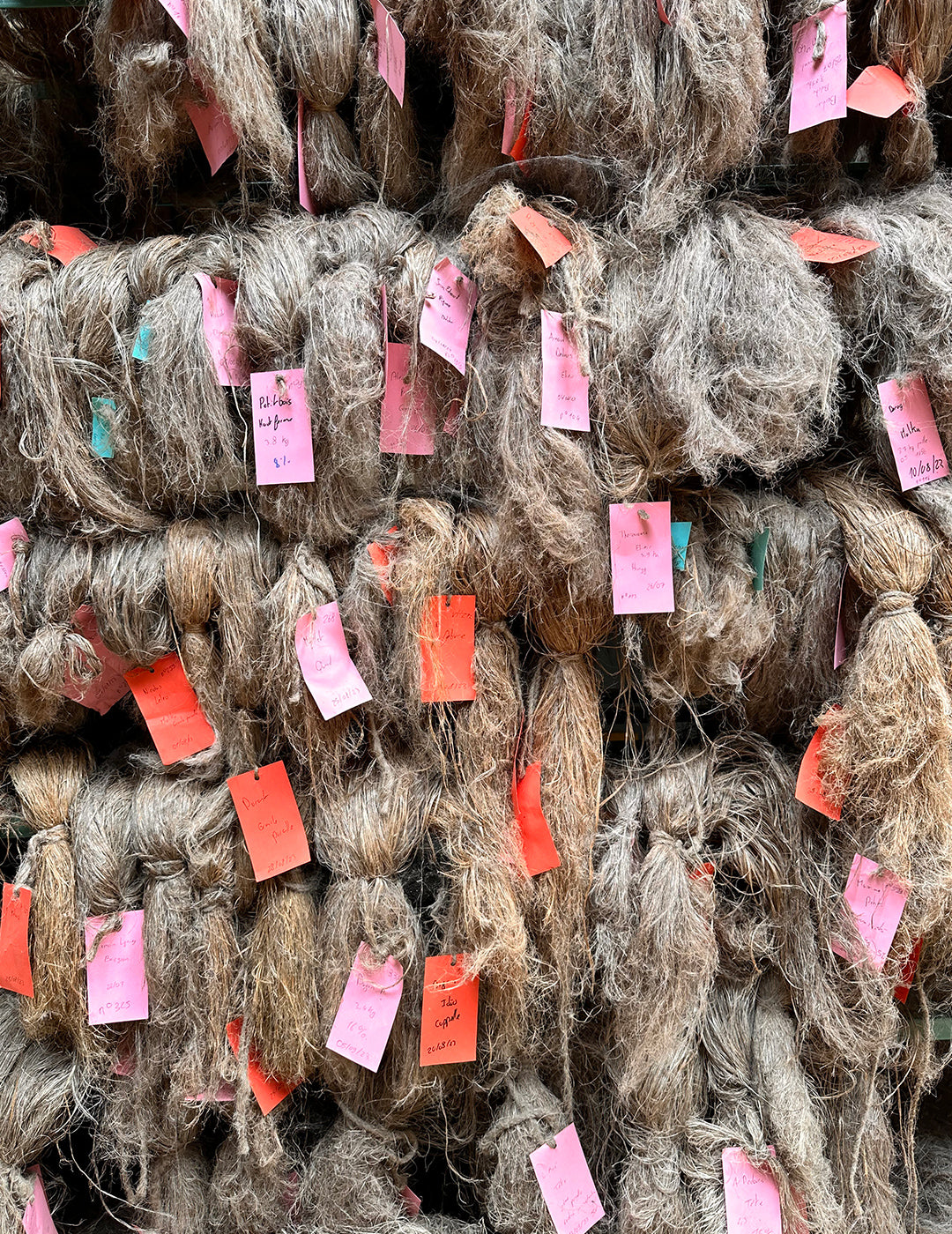
Most of our products are made from natural fibres and produced with long-term manufacturing partners across the UK and Europe, many of whom utilise renewable energy.
Encouraging low-carbon commuting
Our Rewarding Planet Friendly Working Policy encourages employees to travel more sustainably through walking, cycling, lift sharing and public transport.
Waste reduction and circularity
We aim to minimise waste through thoughtful design and production. Surplus fabrics are repurposed into Waste Not Want Not craft packs, recycled into new products such as dog beds, or donated to charities supporting communities in need.
Supporting climate projects
Since 2023, we have partnered with Ecologi to support climate action projects such as tree planting and ecosystem restoration.
Building Our Climate Targets
Our initial Emissions Management Report explored potential emissions reduction pathways, including pathways informed by climate science. These helped us understand the scale of the challenge but did not represent formally adopted Secret Linen Store reduction targets.
We believe our targets should be based on a robust understanding of our emissions and the areas where we can realistically influence change.
That's why we've committed to completing our second comprehensive carbon emissions mapping exercise for FY2025/26.
Having two years of comparable data will allow us to understand how our emissions are changing, identify the reasons behind those changes and continue improving the quality of our data.
We will use this year-on-year assessment to establish clear, measurable and achievable emissions reduction targets that support our commitment to the global ambition of limiting warming to 1.5°C.
Our FY2025/26 Climate Actions
While we develop our longer-term reduction targets, our priorities are clear.
For FY2025/26, we have committed to:
- completing our second comprehensive Scope 1, Scope 2 and Scope 3 emissions mapping exercise;
- comparing our FY2025/26 emissions against our FY2024/25 baseline;
- continuing to improve the quality and accuracy of our emissions data, particularly within our supply chain;
- working with suppliers to improve access to primary environmental and emissions data;
- identifying the key drivers behind year-on-year changes in our emissions;
- prioritising practical reduction opportunities within the areas where we have the greatest impact and influence; and
- establishing measurable longer-term emissions reduction targets following our FY2025/26 emissions review.
Measuring Our Progress
Our Climate Action Plan will be formally reviewed annually, following completion of our emissions assessment.
We'll use this review to compare our performance against our baseline, understand what's changed, assess progress against our climate actions and determine whether our targets and priorities need to evolve.
FY2024/25 gave us our baseline. FY2025/26 will give us our first opportunity to understand our emissions year-on-year.
For a small business like ours, we believe credible climate action means understanding our impact, focusing our resources where they can make the greatest difference, and making commitments that we can measure and stand behind.
We'll continue to share what we learn, the actions we're taking and the progress we're making as our climate journey develops.